Single-band Bethe lattice
In this example, we study a special one-band Hubbard model, which has semi-circular noninteracting density of states (DOS), It corresponds to Bethe lattice with infinite coordination number. You will learn:
How to set up a simple model calculation
How the correlation strength induces metal-insulator transition in the Gutzwiller-slave-boson theory
How to determine the energy gap for the Mott-insulating phase
Time for this part: ~20 minutes.
GRISB calculations with increasing U
There is predefined class, which helps generating the energy mesh with uniform weight.
In the model, we use half-band width as the energy unit. The noninteracting DOS and cumulative dos is shown as below:

The half-circle DOS corresponds to single band on the Bethe lattice in infinite dimenstion or with infinite coordination number. A function to setup the model for CyGutz calculation has been defined,
The system is set as a grand canonical ensemble, with the basic control parameters of Hubbard interaction \(U\), which controls the onsite screened Coulomb interaction strength, and chemical potential \(\mu\), which controld the electron filling. For convenience, we have also predefined a function to run CyGutz for a list of Hubbard \(U\) or chemical potential \(\mu\),
Let us first look at the case of fixed \(\mu=0\), i.e., in the particle-hole symmetric case. We will perform a series of CyGutz calculations with increasing \(U\), and check the behavior of the total energy, double occupancy, and quasi-particle weight (Z`=:math:`R^dagger R). Recall that in Gutzwiller-slave boson theory, Z=0 implies the system is in the Mott insulating phase, where all the spectral weight becomes non-coherent.
A script for a job for scanning a list of \(U\) is defined as
For a hands-on practice, assuminig your current directory is comrisb_tutorial/tutorials/Bethe_Latt/, type the following command to run the job:
$ mkdir -p work && cd work && python3.7 ../scan_semicirc.py
It will automatically generate the following results:
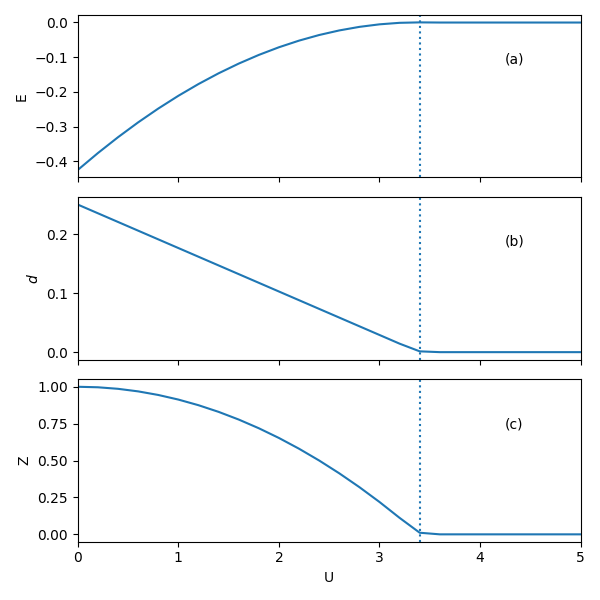
The three panels from top to bottom plot the total energy E, double occupancy d, and quasi-particle weight Z as U increases. When the system transforms from metallic phase to Mott insulating phase, the double occupancy and quasi-particle weight vanish, and the total energy becomes a constant. One can see that the \(U_{c}\) ~ 3.4 for the metal-insulator transition.
Note
This depicts the famous Brinkman-Rice metal-insulator transition picture, which neglects high-energy virtual processes and can be regarded as zeroth order description for the Mott phase. For recent advancement within the generalized Gutzwiller approach, please refer to [Lanata17] and [Frank21].
GRISB Mott gap revealed by scanning chemical potential
Although the theory gives a very simplified picture of the Mott insulator, i.e., double occupancy or quasi-particle weight is 0, it is possible to get the band gap size by varying the chemical potential.
A script for a job of scanning \(\mu\) at \(U=5\) is defined as
Stay in the same work directory and type the following command for calculations to get the band gap:
$ python ../scan_semicirc.py --mu
It will automatically generate the following results:
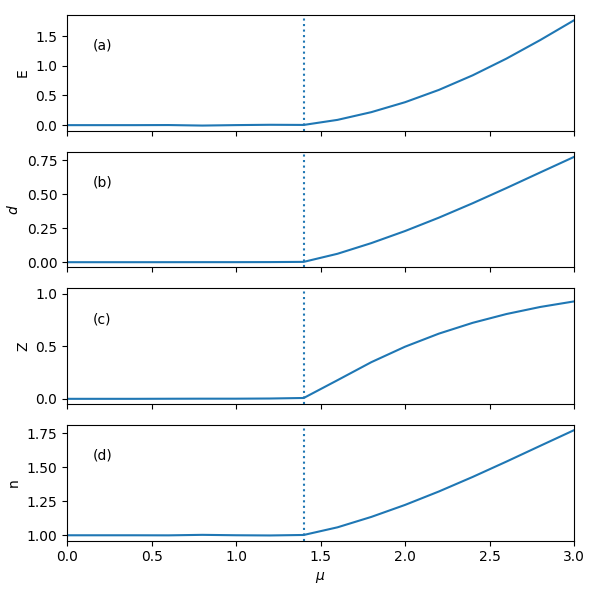
One can see that the physical quantities of interest stay constant in the gap region. When \(\mu\) increases over ~ 1.4, the orbital occupation \(n\) starts to decrease, indicating the gap size ~ 1.4*2 = 2.8. The factor of 2 comes from particle-hole symmetry.
N. Lanata, T.-H. Lee, Y.-X. Yao, and V. Dobrosavljevc, Emergent Bloch Excitations in Mott Matter, Phys. Rev. B 96, 195126 (2017).
M. S. Frank, T.-H. Lee, G. Bhattacharyya, P. K. H. Tsang, V. L. Quito, V. Dobrosavljevic, O. Christiansen, and N. Lanata , Quantum-Embedding Description of the Anderson Lattice Model with the Ghost Gutzwiller Approximation, arXiv:2106.05985 (2021).